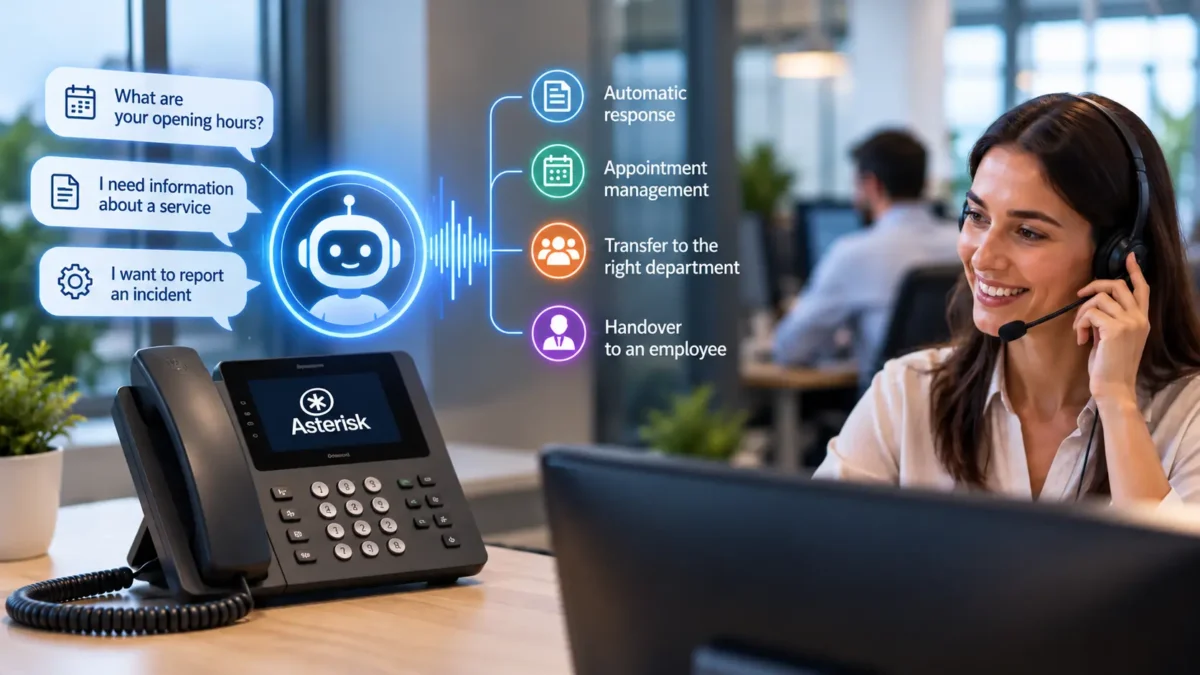
At Inmove IT Solutions, we have introduced a new AI-powered virtual agent service for Asterisk, enabling businesses to take their telephone communications a step further. It allows their phone system to hold conversations with customers, understand requests and handle certain enquiries without human intervention.
This technology goes beyond traditional automated telephone menus. Rather than simply transferring calls between extensions, the phone system can answer frequently asked questions, collect information, identify the reason for a call and route it to the appropriate department when necessary.
For businesses receiving large numbers of calls, this development offers an opportunity to reduce waiting times, minimise interruptions for employees and improve customer service, even outside normal business hours.
But how does a virtual agent integrated with Asterisk actually work? Does it require replacing an existing phone system? Which tasks can it handle, and which should remain in the hands of employees? Below, we explore its capabilities and the benefits it can bring to business communications.
The problem is not receiving too many calls, but how they are handled
For many businesses, the telephone remains one of the main communication channels for customers, suppliers and partners. However, handling every call effectively can become challenging when call volumes increase or staff availability is limited.
The most common problems include:
- Missed calls: when all lines are busy or no employees are available to answer.
- Repetitive enquiries: questions about opening hours, services, availability or procedures that take up a considerable amount of time.
- Unnecessary transfers: calls passed between several employees before reaching the right department.
- Constant interruptions: employees having to stop their work to deal with straightforward requests.
- Limited opening hours: customers needing information when the business is closed.
Traditional phone systems help organise these situations through call queues, extensions and automated response menus. However, these functions do not always resolve the customer’s needs during the call itself.
The difference emerges when the system moves beyond simply routing calls and begins actively helping to resolve enquiries.
From pressing menu options to having a conversation with your phone system
For years, automated telephone systems have relied on predefined menus: press 1 for accounts, press 2 for technical support or press 3 to speak to an operator.
These systems, known as IVR (Interactive Voice Response), remain useful, but they require customers to navigate a fixed set of options that may not match their needs.
A conversational virtual agent introduces a different way of interacting.
Instead of listening to a list of options, customers can simply explain why they are calling. The system processes the request, identifies the intention and responds according to the information and functions configured within it.
For example, a customer might call and say:
“Good morning. I’d like to know whether you can deal with an incident outside your normal working hours.”
Rather than automatically directing the caller to a menu, the virtual agent could explain the relevant support arrangements, request additional information or transfer the call to the appropriate department.
The main difference is that conversations no longer depend entirely on rigid instructions and can adapt to different ways of expressing the same request.
However, this does not mean the system can resolve every situation. Its capabilities depend on the information available, the integrations implemented and the limits established during configuration.
How can an Asterisk phone system incorporate these capabilities?
One of the advantages of this development is that it does not necessarily require businesses to replace their existing telephone infrastructure.
Asterisk is an open-source IP telephony platform used to configure business phone systems with extensions, call queues, schedules, routing rules and connections to external applications.
Its flexibility makes it possible to introduce additional features, including virtual voice agents.
To learn more about the possibilities of this technology, explore our Asterisk IP telephony solutions for businesses.
What happens when a customer calls?
In an automated telephone service configuration, the process could work as follows:
- Call reception: Asterisk receives the call through the company’s usual telephone number.
- Virtual agent interaction: the call is connected to the conversational system, which identifies itself and asks the customer what they need.
- Request interpretation: the agent processes the conversation and identifies the reason for the call.
- Information retrieval: where the necessary integrations are available, it can access authorised business information.
- Response or action: the agent provides information, collects data or performs a previously configured action.
- Transfer to an employee: if the request requires human assistance, the call is routed to the appropriate department.
In this way, Asterisk continues to manage the telephone infrastructure, while the virtual agent adds conversational and automation capabilities.
Businesses can decide when the agent operates, which calls it should handle and under which circumstances a call must be transferred directly to an employee.
Situations where a virtual agent can add value
The benefits of this type of solution become clearer when applied to specific business requirements. The aim is not to automate every conversation, but to identify those that can be handled efficiently and reliably.
Handling frequently asked questions
Imagine a distribution company that receives numerous calls about goods-receiving hours, required documentation or delivery procedures.
A virtual agent configured with this information could answer these enquiries without constantly interrupting the logistics team.
When a question requires a specific decision or information that is unavailable to the system, the call can be transferred to an employee.
Identifying and classifying requests
In a business with several departments, not every call needs to go through reception.
The virtual agent could ask callers why they are getting in touch and identify whether their request relates to accounts, sales, technical support or customer service.
This would allow calls to be directed to the appropriate extension or queue from the outset, avoiding unnecessary transfers.
Collecting information before transferring a call
In some services, handling times can be reduced when employees receive information about an enquiry before speaking to the caller.
For example, in a maintenance company, the system could ask for the customer’s name, the location of an incident and an initial description of the problem.
With a suitable integration into the company’s management system, this information could be recorded or made available to the employee who takes over the call.
Providing assistance outside business hours
Not every business needs employees answering calls around the clock, but some may need to provide information or collect requests while their offices are closed.
A virtual agent can respond to predefined enquiries, take messages or identify situations requiring an escalation procedure.
For genuinely urgent situations, a business can establish rules to direct certain calls to an on-call support service, provided such coverage is available.
Managing appointments and administrative requests
For organisations handling bookings, sales appointments or scheduled visits, a virtual agent can also support certain administrative tasks.
When integrated with suitable applications, it could check availability, suggest appointment times or register booking requests.
These features require connecting the telephone system to the relevant applications and defining appropriate permissions, validation processes and confirmation procedures.
What benefits can businesses actually expect?
The value of intelligent telephone support is not simply that a machine can hold a conversation. It lies in how this capability can improve work organisation and the experience of people contacting the business.
- Greater call-handling capacity: certain requests can be resolved without depending on the immediate availability of an operator, within the agreed service capacity.
- Fewer interruptions: employees can focus on tasks requiring specialist knowledge or human judgement.
- More consistent responses: frequently asked questions can be handled using previously approved information and procedures.
- Improved call distribution: identifying the reason for contact at the outset enables more accurate routing.
- Extended availability: selected telephone support functions can remain operational outside office hours.
- Better use of existing infrastructure: businesses using Asterisk can explore additional capabilities without necessarily replacing their phone system.
Cost savings may also be possible, although they should not be taken for granted. They depend on call volumes, minutes used, required integrations and ongoing maintenance costs.
It is therefore important to assess projects against measurable indicators rather than relying solely on expectations of lower costs.
Automating calls does not mean removing the human element
One of the main concerns when introducing these solutions is that telephone support may become less personal or that customers may find it difficult to speak to a real person.
A properly designed implementation should avoid precisely this situation.
The aim is for the virtual agent to handle interactions it can resolve correctly, allowing employees to focus on situations requiring experience, empathy or decision-making.
For example, an enquiry about office opening hours can be answered automatically. By contrast, a complex complaint, critical incident or commercial negotiation should have a clear route to a member of staff.
It is also important to define what should happen when the agent does not understand a request, encounters conflicting information or lacks sufficient information to respond.
In these situations, the appropriate approach is to acknowledge the limitation and offer an alternative rather than providing an unreliable answer.
Security and data protection: essential considerations
Introducing a virtual agent into business telephony involves processing conversations that may contain personal, commercial or confidential information.
Data protection must therefore be considered from the earliest stages of the project.
Key areas to review include:
- Informing callers that they are interacting with an artificial intelligence system.
- Determining what personal data the agent needs to collect and for what purpose.
- Establishing appropriate rules for recording and retaining conversations where applicable.
- Controlling access to transcripts, logs and information retrieved from business applications.
- Reviewing where data is processed and stored and which providers are involved.
- Applying appropriate security measures to communications and connections between systems.
In addition to the General Data Protection Regulation (GDPR), businesses must consider the transparency obligations applicable to artificial intelligence systems.
The Spanish Data Protection Agency (AEPD) provides information about privacy obligations, personal data processing and the use of automated technologies.
A technically advanced solution is only valuable to a business if it can also be operated securely, under appropriate controls and in accordance with applicable legal requirements.
What should a business review before introducing a virtual agent?
Before deploying an intelligent telephone support solution, businesses should examine how their current phone system operates and identify the processes that genuinely need improvement.
A well-planned project should include:
- Analysing current calls: identifying peak periods, common enquiries, missed calls and waiting times.
- Selecting suitable processes: starting with repetitive, low-complexity requests.
- Reviewing the infrastructure: checking the Asterisk version, telephone configuration and connectivity requirements.
- Defining integrations: determining whether the agent needs access to a CRM, calendar, database or other applications.
- Designing call transfers: establishing how and when calls should be passed to employees.
- Carrying out tests: checking speech understanding, voice quality, response times and behaviour when errors occur.
- Measuring results: monitoring metrics such as successfully resolved enquiries, correct transfers, abandoned calls and customer satisfaction.
Automated conversations also involve operating costs, including speech processing, the AI models used, communications and the hosting infrastructure.
For this reason, the solution should be sized according to each organisation’s actual requirements.
Asterisk: an infrastructure ready to evolve
Businesses already using an Asterisk phone system have a flexible platform on which additional telephone support capabilities can be built.
Its open architecture allows tailored integrations to be considered, existing extensions to be reused and different call flows to be established according to each organisation’s requirements.
The phone system can also be deployed on-premises, in the cloud or through hybrid architectures, provided the infrastructure and integrations are compatible.
At Inmove IT Solutions, we work with cloud and on-premises business phone systems, tailoring the architecture to each customer’s availability, management and growth requirements.
Introducing a virtual agent represents a further step: moving from simply managing communications to automating certain processes that take place during those communications.
It is not about replacing the phone system with an artificial intelligence tool, but about using existing infrastructure to extend its capabilities.
Frequently asked questions about virtual agents and Asterisk phone systems
Before adopting this technology, businesses often have questions about compatibility, costs, security and how automated telephone support works.
Do we need to replace our phone system to use a virtual agent?
Not necessarily. If a business already has a compatible Asterisk phone system, integrating a virtual agent may be possible without replacing the entire infrastructure. The existing configuration and technical requirements will need to be reviewed.
Can a virtual agent transfer calls to an employee?
Yes. With a suitable integration, it can transfer calls to extensions, groups or call queues. Businesses can define which situations require human assistance and establish the relevant routing criteria.
Can it answer questions about our products and services?
Yes, provided it has access to accurate, up-to-date and properly structured business information. Responses should be restricted to authorised content, with safeguards to reduce incorrect or unverified information.
Can it integrate with our CRM or management software?
Integrations with business applications can be considered through APIs or other compatible mechanisms. Feasibility depends on the software involved, available permissions and the functionality required.
Can it answer calls outside office hours?
Yes. A virtual agent can be configured to handle selected enquiries outside normal working hours, collect requests or route incidents according to predefined rules. Actual availability depends on the infrastructure and services contracted.
How much does it cost to add a virtual agent to Asterisk?
Costs depend on call volumes and duration, speech-processing technology, integrations, hosting infrastructure and ongoing maintenance requirements. The most appropriate approach is therefore to size the service around each business’s needs.
A new approach to business telephone support
For many years, the primary purpose of a business phone system has been to receive calls and direct them to the right person.
Today, it can play a much broader role: understanding certain requests, providing information, automating tasks and helping communications run more efficiently.
The objective is not to replace human contact, but to ensure that every call receives appropriate attention and that employees spend their time on tasks genuinely requiring their involvement.
For businesses using Asterisk, this development creates new opportunities without giving up the flexibility and control of their communications platform.
Would you like to explore how these capabilities could be added to your phone system? At Inmove IT Solutions, we can assess your telephone infrastructure and explore a solution tailored to your processes. Discover our AI-powered virtual agent service for Asterisk.
Does your business need to improve call handling and reduce repetitive tasks? Contact us and tell us what you need. We can help you assess the opportunities for automating your business telephony.