
European technological sovereignty is no longer a debate reserved for governments, large corporations or public institutions. In 2026, it has become a strategic issue for any business that depends on the cloud, data, artificial intelligence, software providers or the continuity of its IT systems.
For years, many organisations have built their technological infrastructure on global platforms that are very powerful, but also highly concentrated. Public cloud, collaboration suites, AI services, chips, cybersecurity tools, storage and critical software often depend on a small number of international providers.
This does not mean these solutions should be rejected. In many cases, they are useful, mature and necessary. But it does raise an important question: how much real control does your business have over its data, its systems and its ability to continue operating if the rules of the game change?
In this article, we analyse what European technological sovereignty means, why it directly affects businesses and how to make more balanced decisions in areas such as cloud, chips, AI and open source.
What is European technological sovereignty?
European technological sovereignty is the ability of Europe, its businesses and institutions to control critical technologies, reduce excessive dependencies and ensure that data, infrastructures and digital services are managed according to security, transparency and autonomy criteria.
It is not about isolation or stopping work with international providers. The key is to avoid absolute dependence on technologies that the business cannot audit, move, replace or control in the event of a legal, economic, commercial or geopolitical conflict.
For a business, digital sovereignty translates into very specific decisions:
- Knowing where data is hosted and under which jurisdiction.
- Reducing technological lock-in with a single provider.
- Designing reversible and well-documented cloud architectures.
- Combining proprietary and open source solutions with business criteria.
- Assessing AI risks before integrating it into critical processes.
- Ensuring backups, continuity and recovery capability.
This approach is especially relevant for businesses that work with sensitive information, customer data, intellectual property, industrial processes, healthcare, financial services, logistics or any activity where a technological interruption can directly affect operations.
European technological sovereignty and cloud: it is not only where you host, but how you stay in control
The cloud is one of the central points in the debate on European technological sovereignty. Many businesses use cloud services to host servers, applications, virtual desktops, backups, IP telephony or collaborative environments. This provides flexibility, scalability and a reduction in local infrastructure.
The problem arises when all operations depend on a single platform, without a clear exit strategy, without documentation, without external copies, without contractual control or without visibility over where data is stored.
A sovereign cloud approach does not necessarily mean using only European providers. It means designing an architecture where the business retains decision-making capacity, mobility and recovery capability. To achieve this, it is advisable to review aspects such as:
- Location of the data and data centres used.
- Portability and information export conditions.
- Compatibility with hybrid or multicloud environments.
- Backup policies independent from the main provider.
- Access control, encryption and permission segregation.
- Contingency plan if the provider fails or changes conditions.
At Inmove IT Solutions, we approach these scenarios from a practical perspective, combining cloud infrastructure, backup, security and support. If your business wants to review its current dependence on cloud providers, you can learn more about our cloud computing solutions for businesses.
Chips and semiconductors: the invisible side of digital sovereignty
When we talk about European technological sovereignty, we often think of software, cloud or data. However, the physical foundation of the entire digital infrastructure lies in chips and semiconductors.
Servers, firewalls, switches, computers, mobile devices, storage systems, industrial systems, IoT sensors and artificial intelligence platforms depend on semiconductors. If the supply chain breaks, becomes more expensive or is conditioned by external decisions, businesses may suffer delays, lack of stock, cost increases or difficulties renewing critical infrastructure.
For an SME or medium-sized company, the impact is not usually seen in major headlines, but in very specific problems:
- Hardware renewals delayed for months.
- Network equipment or servers with unexpected extra costs.
- Dependence on manufacturers with very closed support cycles.
- Difficulty maintaining spare parts for critical infrastructures.
- Obsolescence of systems that no longer receive updates.
Technological sovereignty also means better planning of the hardware lifecycle. It is not enough to buy equipment when it fails. It is necessary to inventory, anticipate renewals, review warranties, evaluate compatibility and define which systems are truly critical.
An IT systems audit helps identify hidden dependencies, obsolete equipment, continuity risks and areas where it is advisable to modernise the infrastructure before problems appear.
AI and technological sovereignty: data, traceability and control
Artificial intelligence is another major pillar of European technological sovereignty. More and more businesses are using AI tools to draft documents, analyse data, automate tasks, classify incidents, respond to queries, generate code or support commercial processes.
The risk is not in using AI, but in doing so without governance. A business must know what data it enters into these platforms, which providers are involved, where information is processed, whether it is reused for training, what permissions users have and which critical processes depend on automatically generated results.
From a business perspective, a responsible AI strategy should include:
- Internal policy for the use of AI tools.
- Classification of data that can or cannot be shared.
- Review of provider contracts and terms.
- Access control and activity logging.
- Human validation for sensitive decisions.
- Assessment of legal, technical and reputational risks.
The European Commission has placed AI at the centre of its technological strategy. For businesses, this represents an opportunity, but also an obligation: adopting AI with security, traceability and common sense.
Before integrating AI into internal processes, it is advisable to review the technological foundation: permissions, identities, perimeter security, data protection, backups and monitoring. AI connected to poorly governed systems can amplify errors, expose information or automate bad practices.
Open source: a realistic way to gain technological control
Open source plays an increasingly important role in European technological sovereignty. Not because everything has to be free software, but because many open source solutions help reduce dependence on closed licences, improve transparency and adapt systems to the real needs of the business.
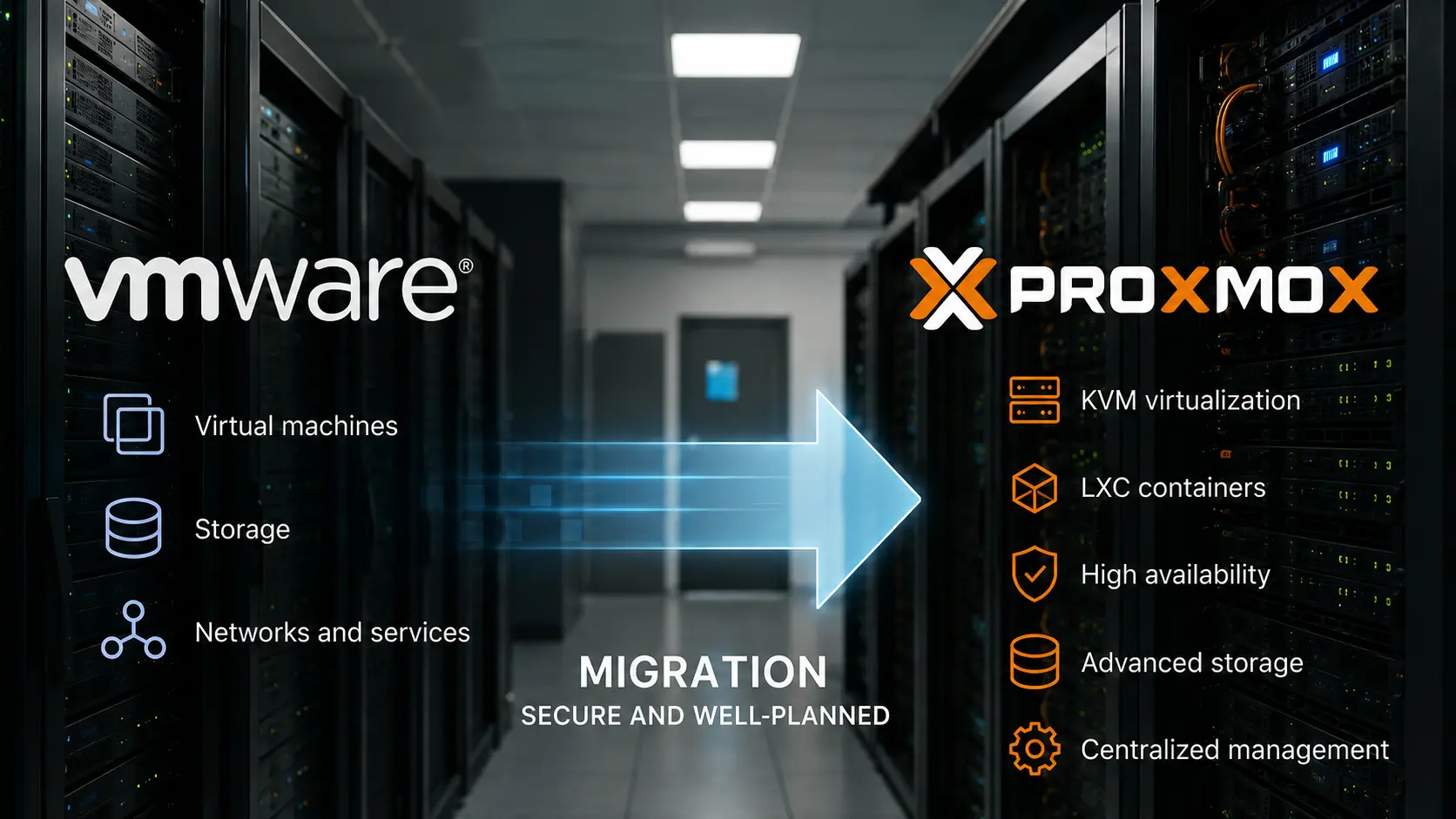
Tools such as Linux, Proxmox, Nextcloud, Asterisk, Zabbix, PostgreSQL or monitoring and virtualisation solutions can provide significant value when implemented with professional criteria.
But it is important to avoid a common misconception: open source does not mean “free and maintenance-free”. An enterprise open source solution requires design, secure configuration, updates, documentation, backups, monitoring and specialist support.
When properly planned, open source can help a business to:
- Reduce recurring licence costs.
- Avoid lock-in with specific manufacturers.
- Customise solutions according to internal processes.
- Audit certain technological components more effectively.
- Combine cloud, on-premise and hybrid environments.
- Build more flexible and maintainable platforms.
At Inmove IT Solutions, we implement open source solutions from a business perspective, not as isolated tools. We analyse needs, select technology, design architecture, integrate systems and provide ongoing support. You can find out more on our open source solutions for businesses page.
What should a business review to improve its technological sovereignty?
European technological sovereignty may seem like a broad concept, but it can be translated into a very specific review of the IT environment. The goal is not to change everything, but to identify critical dependencies and reduce risks progressively.
A business can start with these areas:
- Technology provider map: cloud, software, communications, security, backup, hardware and support.
- Critical data inventory: what information is stored, where it is, who accesses it and how it is protected.
- Cloud dependencies: which services are essential and what alternatives exist if they fail.
- Portability: real possibility of moving data, virtual machines, services or applications.
- Independent backup: copies separated from the main environment and periodic restoration tests.
- Critical software: review of licences, support, integrations and open source alternatives.
- AI and automation: control of data, permissions and processes where artificial intelligence is used.
- Cybersecurity: network segmentation, firewall, MFA, updates and monitoring.
This analysis enables data-driven decisions. In some cases, it will be enough to improve backups, document access or review contracts. In others, it may be advisable to redesign part of the infrastructure, deploy hybrid services or adopt more open technologies.
The role of backup and continuity in digital sovereignty
A business does not have real technological sovereignty if it cannot recover its systems. It may have good providers, good applications and an advanced cloud strategy, but if it does not have verified backups, its autonomy is limited.
Backup is a critical component because it allows businesses to respond to ransomware, human errors, accidental deletions, provider failures, data corruption or synchronisation problems. It also provides room for manoeuvre if a business needs to migrate services, rebuild infrastructure or recover information outside the main environment.
To strengthen technological sovereignty, backups should meet several requirements:
- Be separated from the main system.
- Include encryption in transit and at rest.
- Provide sufficient retention according to business needs.
- Be tested periodically through real restorations.
- Be protected against unauthorised access.
- Be documented within the continuity plan.
If your business needs to strengthen this area, you can review our business cloud backup in a private cloud service, designed to protect critical data and systems with a continuity-focused approach.
Technological sovereignty does not mean choosing between Europe and major providers
An overly simplistic interpretation of European technological sovereignty would be to think that businesses must replace all their current tools with European or open source alternatives. In practice, that decision is not always viable or advisable.
Most businesses need a hybrid approach. Some global solutions will continue to be necessary due to maturity, integration or functionality. Other areas may benefit from European alternatives, private platforms, open source solutions or local providers with greater proximity and support capacity.
What matters is that the business has a conscious strategy. In other words, that it knows what risks it assumes, what alternatives it has, how it protects its data and what reaction capacity it retains.
At this point, perimeter security, network segmentation and access control are also essential. You can complement your cloud and open source strategy with perimeter security solutions for businesses, especially if you work with hybrid environments, connected sites or services exposed to the Internet.
How Inmove IT Solutions can help you
At Inmove IT Solutions, we help businesses build more secure, flexible and controllable technology environments. Technological sovereignty is not achieved with a single tool, but with a well-designed architecture and continuous management.
Our approach combines technical analysis, cloud computing, open source, cybersecurity, backup, communications, support and maintenance. The goal is for each business to modernise its infrastructure without losing control over its data, its systems and its operational continuity.
We can help you to:
- Review current technological dependencies.
- Design cloud, hybrid or private environments.
- Implement open source solutions with professional support.
- Protect data through cloud backup and recovery policies.
- Strengthen perimeter security, access and segmentation.
- Document infrastructure and improve business continuity.
- Assess the safe use of AI and new digital tools.
European technological sovereignty is not a trend. It is a way to reduce risks, improve resilience and make better decisions about the digital infrastructure that supports your business.
Conclusion: more control, less dependence and better IT decisions
European technological sovereignty is gaining prominence because businesses increasingly depend on the cloud, data, chips, AI and software to operate. This dependence is not negative in itself, but it must be managed with clear criteria.
The challenge is not to replace all current technology, but to build a more balanced strategy. A strategy that combines reliable providers, controlled infrastructure, open source solutions when they add value, independent backups, solid security and recovery capacity.
For many businesses, the first step will not be to change provider, but to review what they have, where their data is, what risks exist and what real alternatives they could activate if necessary.
If you want to move towards a more flexible, secure and future-ready infrastructure, Inmove IT Solutions can help you analyse your environment and define a realistic plan.
Frequently asked questions about European technological sovereignty
Below, we answer some common questions about digital sovereignty, cloud, AI and open source in a business context.
What does technological sovereignty mean for a business?
It means having greater control over the data, systems, providers and infrastructures that support the business. It does not mean stopping the use of international technology, but avoiding excessive dependencies and ensuring recovery, migration and decision-making capability.
Does technological sovereignty require using only European providers?
No. In many cases, businesses will continue to use global providers. The important thing is to assess risks, review contracts, ensure data portability, protect access and complement the architecture with solutions that provide greater control.
What role does open source play in digital sovereignty?
Open source can reduce dependence on proprietary licences, improve transparency and allow greater customisation. However, it must be implemented with professional support, updates, documentation, monitoring and security policies.
How does AI affect technological sovereignty?
AI has an impact because many tools process business data on external platforms. Businesses must control what information is shared, who accesses it, how results are validated and which processes depend on automated systems.
Where should a business start?
The first step is to carry out a review of the IT environment: providers, critical data, backups, access, cloud dependence, essential software, hardware, AI and continuity. From there, a realistic improvement plan can be prioritised.
If your business wants to reduce technological dependence and gain control over its infrastructure, the first step is to analyse which systems it uses, where its data is and what risks exist in the event of downtime, provider change or a security incident.
At Inmove IT Solutions, we can help you review your cloud environment, your open source solutions, your backups and your continuity strategy to build a more flexible and secure infrastructure.
You can also contact our team to study your case and assess which measures make the most sense for your business.